
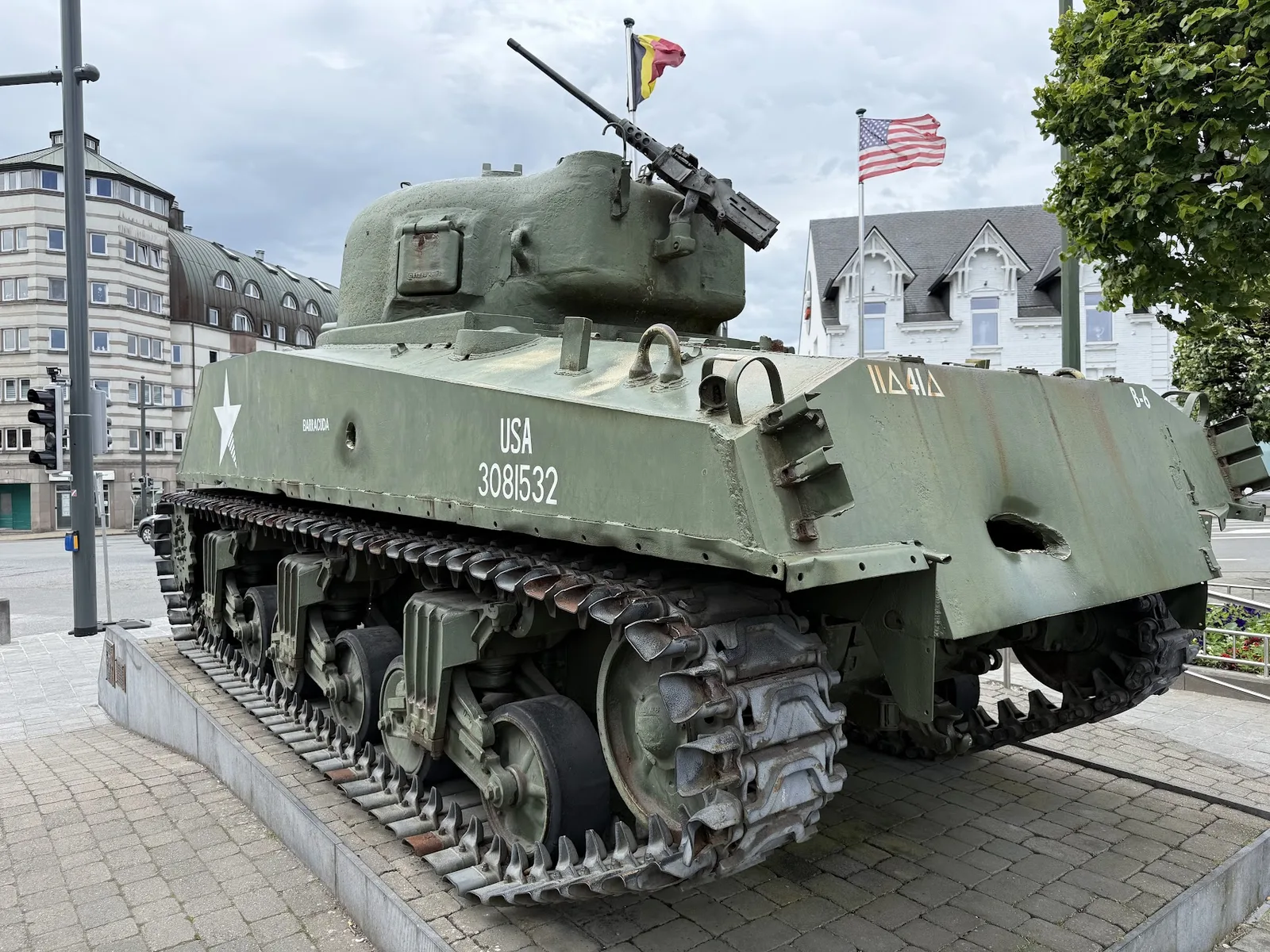
A Sherman tank stands at the entrance to Place Général McAuliffe in the centre of Bastogne. Most people photograph it and walk on. Look closer and you find two holes in the armour, both still open. One is a clean punch through the left side, made by a German 75mm armour-piercing round. The other, in the rear, is jagged and torn, the work of a Panzerfaust. Four of the five men inside survived the war. Two of them came close to being shot after the fighting was over.
The tank is an M4A3(75)W Sherman, serial S48935, named Barracuda by its crew. It served with B Company, 41st Tank Battalion, 11th Armored Division. On 30 December 1944 the division was attacking the southern flank of the Bulge, trying to widen the corridor that had been opened into the besieged Bastogne perimeter. The crew did not know they were driving into a German counter-attack aimed at closing that same corridor.

Barracuda, commanded by Staff Sergeant Wallace Alexander, became separated from its unit near the village of Renuamont, a few kilometres west of Bastogne. (The name appears as both Renuamont and Renaumont in the records. The Bastogne historians who traced the tank’s history use Renuamont.) Trying to turn and pull back across a field, the tank reversed into a snow-covered, spring-fed pond and stuck fast. Static and exposed, it was an easy target. A Panzer IV opened up with its 75mm gun. An infantryman hit it with a Panzerfaust. The crew bailed out. Alexander was badly wounded and died a few days later, a prisoner.
The other four were captured. Gunner Cecil Peterman and loader Dage Herbert were wounded, treated, and sent to a prison camp. Driver Andrew Urda and bow gunner Ivan Goldstein were unhurt, but their war did not get easier. Both were identified as Jewish from their dog tags. Goldstein was also carrying a letter from his mother reminding him to observe Hanukkah. The two were pulled out of the normal prisoner system and put to work as slave labour, starved and overworked. They narrowly escaped execution. Both reached liberation, but barely, and spent months in US Army hospitals recovering from starvation. Urda never fully recovered and died in 1979. Goldstein’s health was eventually restored, and he later moved to Jerusalem.
The tank survived for a reason that has nothing to do with the battle. After the war, the wrecks left across the Ardennes were cut up for scrap where they lay. The farmer who owned the land refused to let the scrap crews cut Barracuda apart on the spot, fearing the work would foul the spring that fed his house and his animals. The Belgian army towed it away whole instead. By then it was one of very few intact tanks left. Bastogne’s tourism office saw its value, bought it, and had it restored. It has stood on McAuliffe Square since 1946.
I bring National WWII Museum groups to this square on my Bastogne battlefield tour, and the tank is usually the first thing they want to understand. The plaque in front of it now carries the names of the crew.