
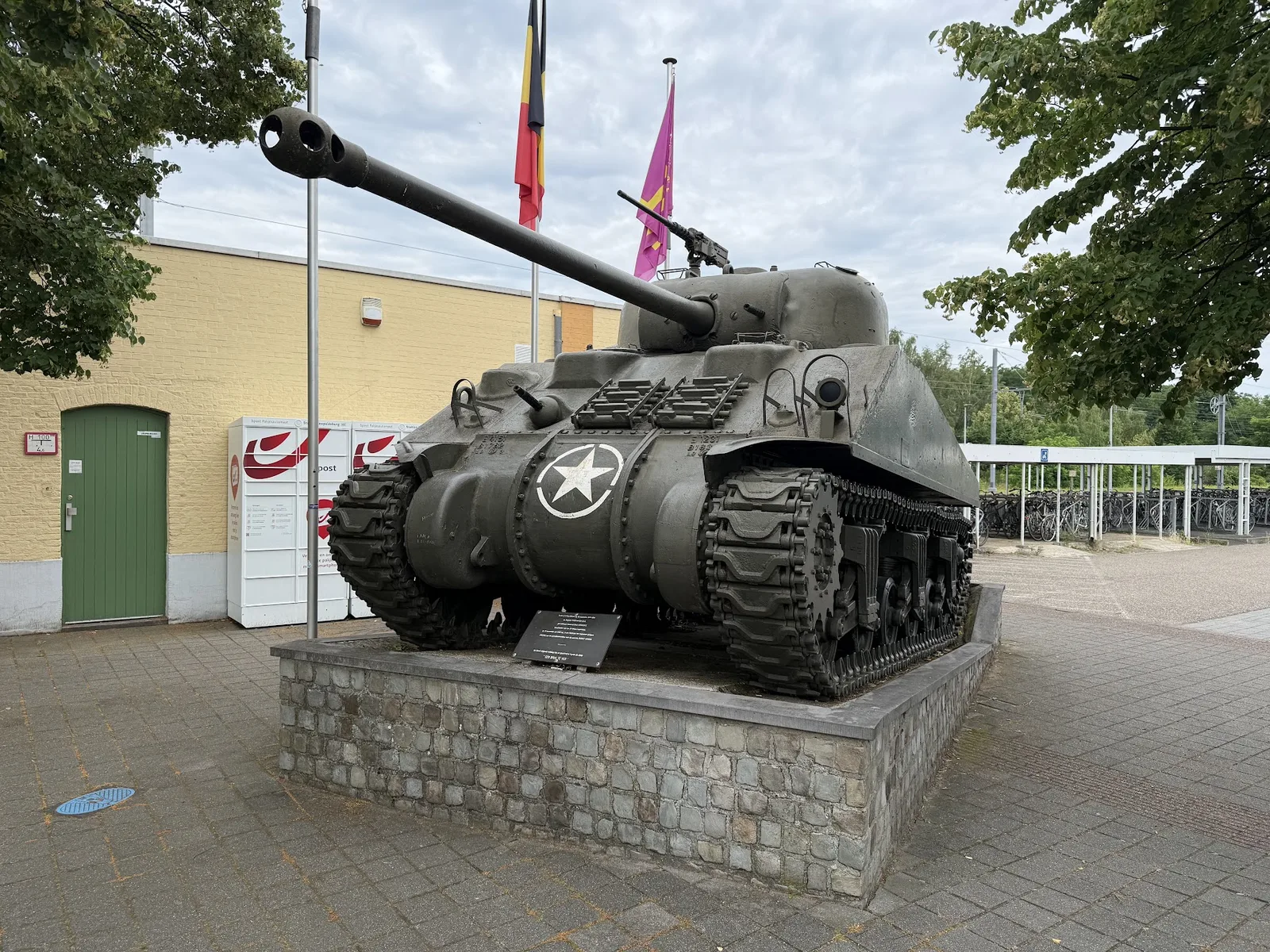
A Sherman tank stands outside the railway station at Leopoldsburg, in northern Belgium. Most people walk past it. It marks one of the quietest turning points of the war in the west: the morning the ground plan for Operation Market Garden was handed to the men who would carry it out.
A cinema called the Splendid

“This is a story you will tell your grandchildren, and mightily bored they’ll be.” Edward Fox delivers the line as Lieutenant-General Brian Horrocks in the film A Bridge Too Far. The detail of the scene is invented, but the place was real. It stood opposite the station: a small cinema called the Splendid.
On the morning of 16 September 1944, Horrocks gathered the commanders of XXX Corps inside it and gave out the orders for Operation Market Garden, the attack that would begin the next day.
There was not a steel helmet in the room. The officers wore berets of every colour and whatever kept them warm. Horrocks himself stood in a woolly jumper and a camouflaged airborne smock. He later wrote that the sight would have sent George Patton through the roof. In the American army, dress was strict. Horrocks ran his briefings the other way.
The mood was casual and cheerful, and he worked to keep it so. He had fought alongside many of these men since Alamein and thought of them as old friends more than subordinates.
The plan on the stage

A vast hand-drawn map hung on the stage. Horrocks had learned from Montgomery the value of a simple order that everyone in the room could see at once. The objective ran north: a single road through Eindhoven, Nijmegen and Arnhem, on towards the IJsselmeer. Airborne troops would seize the bridges. XXX Corps would drive up the road to relieve them.
He had held the orders back on purpose. Issuing them too early was dangerous, he reckoned, because one captured officer could give the whole plan away. The ammunition was already dumped, the guns surveyed into position, the engineers’ work prepared. Only the route remained to be told.
Horrocks asked for questions and got few. He noticed how thoughtful the room looked as it emptied, the Irish Guards most of all. They had reason to be. The next morning they led XXX Corps out of its bridgehead and up the road, the first to test whether the plan would hold.
Leopoldsburg is where I begin my Market Garden tours, with the 30th Corps breakout, before the route turns north towards Arnhem.
What stands there now

Leopoldsburg had been free for only days. The Brigade Piron liberated the town on 12 September 1944. Four days later it became the start line for the largest airborne operation yet attempted.
The Splendid did not survive. Fire destroyed it in 1979, and the remains were cleared for new building. A small plaque on the apartment block at Nicolaylaan 49 is all that marks the spot.
The tank is a later addition, dedicated as a monument in October 1984, on the fortieth anniversary of the briefing. It is not a veteran of the operation. It is an M4A4 Sherman hull married to a Firefly turret, recovered from a firing range and rebuilt by the Belgian army. The Firefly was the up-gunned Sherman, the one Allied tank whose 17-pounder could kill a Panther head on. This one never fired a shot in anger.
The plaque on the monument dates the briefing to 15 September. Horrocks’s own account places it on the 16th, the day before D-Day. The difference is small, but worth knowing if you stand and read it.