
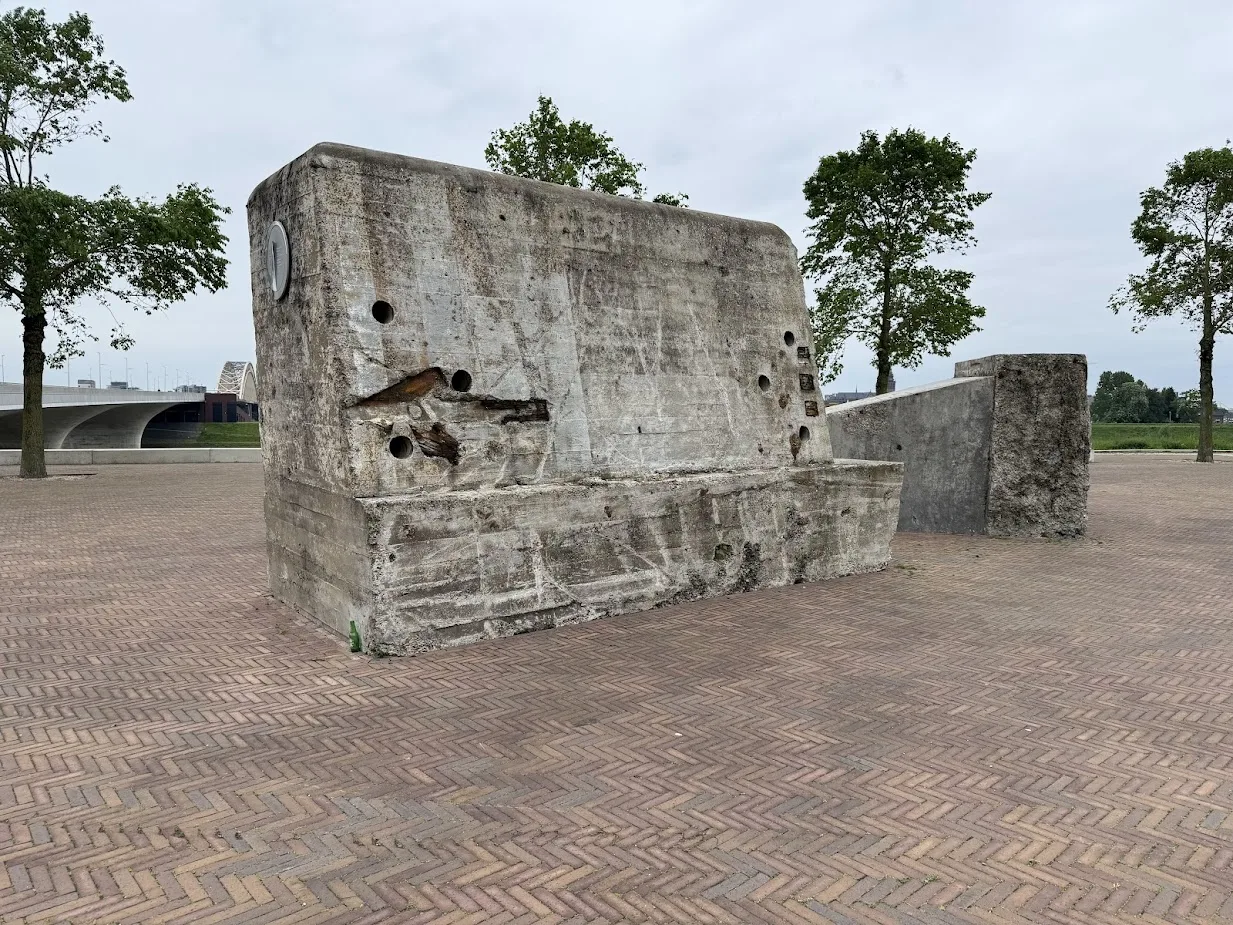
On the north bank of the Waal at Nijmegen, close to where the road bridge comes down on the Lent side, two grey concrete blocks stand in the open. They are scarred, weathered, and easy to walk past without a second look. They are also among the last surviving pieces of German road defence of their kind anywhere in the Netherlands.
The blocks are part of a Panzerkampfwagenmauer, an anti-tank wall the Germans built across the northern approach to the bridge in 1943. Each block stands 3.4 metres high and 2.3 metres wide, with a broad base that originally sat buried in the ground. They were rated to stop tanks up to 60 tonnes.
Why build them here at all? The answer lies in a change of German strategy. Before the war, the western border of the Reich had been protected by the Westwall. After the victories of 1940 the front lay on the Atlantic coast, and the older line was left behind. In 1943 the plans were reviewed, and the decision was taken to pull the western defences back onto the higher ground along the Maas, with the Waal closing the northern flank through the Maas-Waal canal. That brought Nijmegen inside the defended zone of the Reich and turned the Waal road bridge back into a strategic objective. Concrete went into both banks.

Five blocks stood across the northern road, set diagonally rather than square on. The angle was deliberate. It forced every approaching vehicle to slow and weave through the gaps rather than run straight at the barrier. Two narrow passages were left for pedestrians and cyclists, and two wider openings of about 2.5 metres for vehicles. Wooden arrows and painted red-and-white markings showed drivers which side to take. Round holes in the concrete held reflectors, so that drivers using wartime blackout lighting could still find their way through in the dark. The openings could be closed with Frisian horses, portable barbed-wire frames, and steel cables threaded through the blocks.
Dutch Resistance
None of this was a secret from the Allies. The Dutch resistance followed the German construction closely, measured the obstacle in the open, and passed the details into a wider report on the German defences dated 21 March 1944. By the time the planners of Operation Market Garden looked at the northern approach in September 1944, they already knew what stood there. What helped the Allies in the planning helped the Germans on the ground: the ready-made trenches, bunkers, fortified houses, and barriers proved very useful when the defence had to be thrown together in haste on the afternoon of 17 September 1944.

Allied troops took the position on the evening of 20 September 1944. Soon afterwards they removed the centre block to clear the road for traffic. The rest were pushed off onto the floodplain, where they sank into the soft soil and were gradually lost from view. Across the country, German road obstacles were among the first things cleared in the rebuilding after the war, which is why almost none survive. These blocks survived precisely because nobody troubled to haul them away.
They came back to light in August 2013, when contractors widening the Waal floodplain struck something solid in the embankment. With support from the V-Fonds, two of the blocks were lifted, kept, and later set back close to their original position. One still carries part of its red-and-white paint and a wooden direction arrow. Look closely and you can still read the bullet and shrapnel damage from 20 September 1944 in the concrete.
We stop at these blocks on some of our Market Garden tours. They are an easy thing to miss and one of the most direct surviving traces of the fighting for the Nijmegen bridge.
