
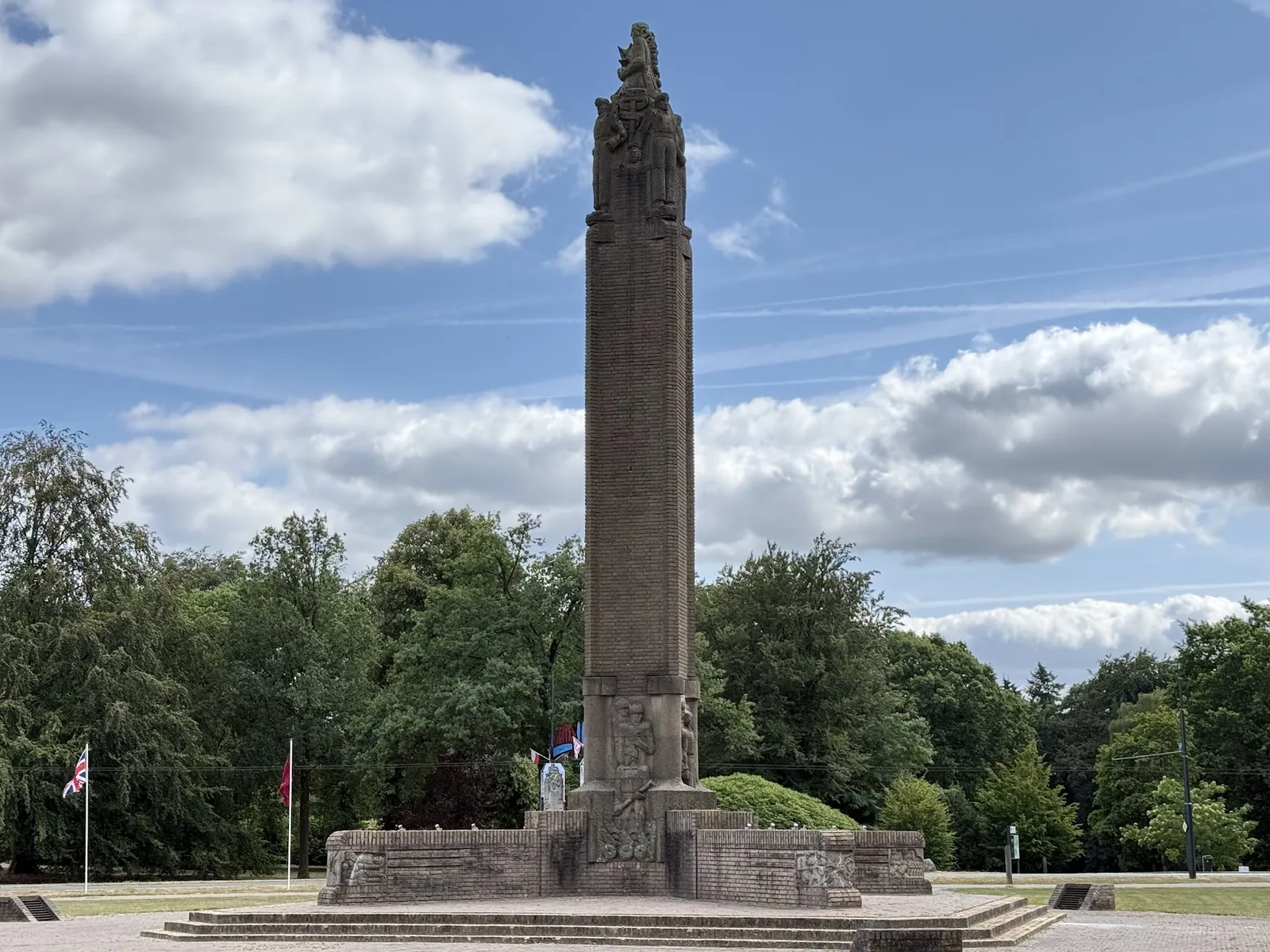
De Naald stands in a small park on the Utrechtseweg in Oosterbeek, directly opposite the Airborne Museum at Hartenstein. A stone column, crowned with figures, on the ground where Major-General Roy Urquhart held his divisional headquarters through the nine days of the battle. The people who built it had every reason to resent the men it honours, and did not.
In September 1944 the 1st British Airborne Division landed west of Arnhem to take the road bridge over the Lower Rhine. Within a week the division had been forced back into a shrinking perimeter around Oosterbeek. On the night of 25 September the survivors crossed the river out of the perimeter. Around 2,400 men got across. The rest were dead, wounded or taken prisoner. The Germans then evacuated the civilian population, and Oosterbeek spent the following eight months emptied of its people and largely in ruins.
When the villagers came home in 1945 they returned to a wreck. Field graves were scattered through the gardens and along the roads, marked with crosses of branches. That summer a British detachment began locating them for reburial. By July they had found around 1,100, only 400 with names.
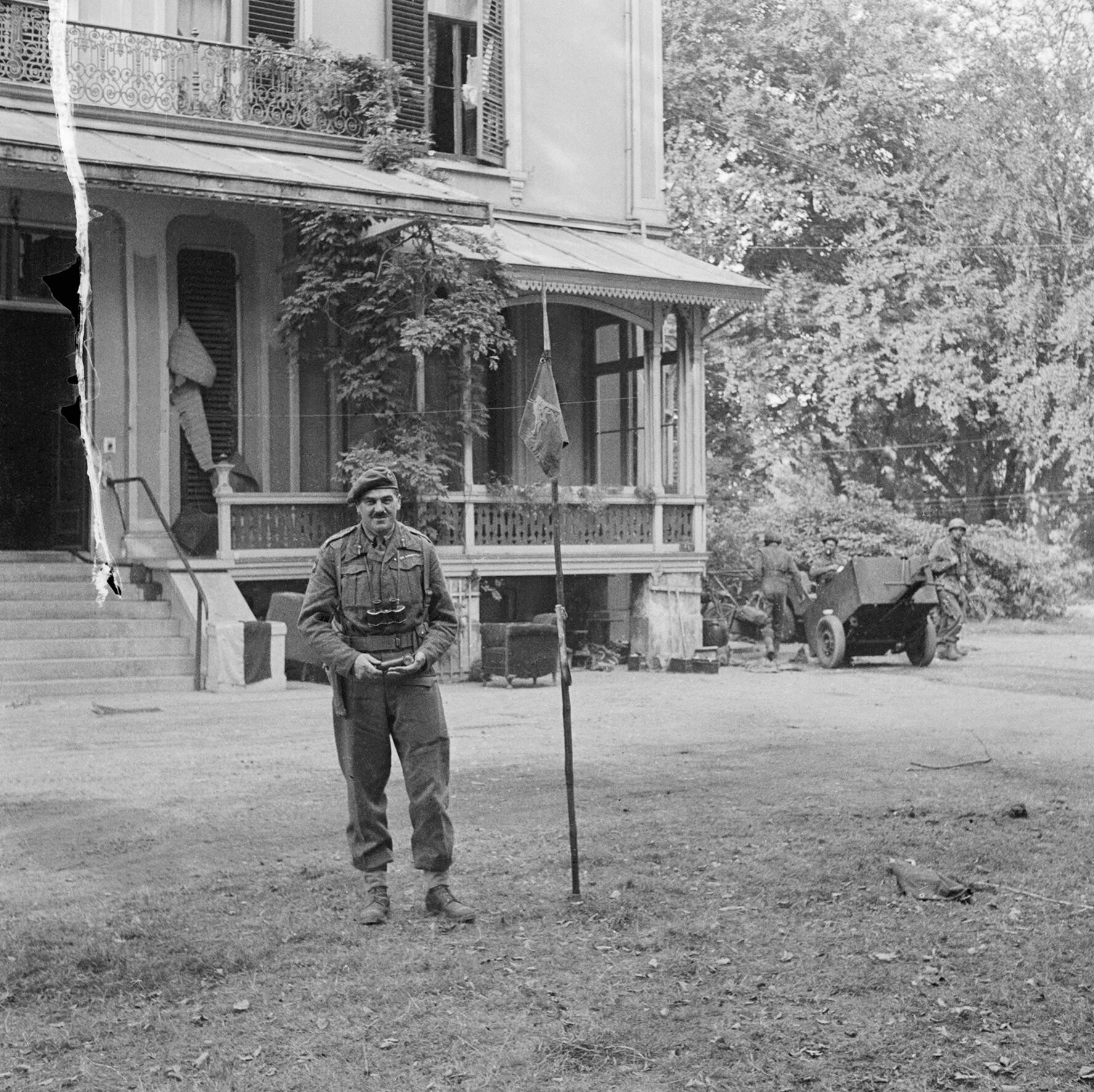
Urquhart was in Oosterbeek himself that July, while British veterans re-enacted the battle for the film Theirs is the Glory. He expected to be blamed. He was not. Speaking to the Arnhems Dagblad on 19 July 1945, he said that to his surprise the British were welcomed everywhere, when he had expected exactly the opposite given all the recent hardship.
The point was made to him plainly that September. Jan ter Horst, then interim burgomaster of Renkum, heard that Urquhart was paying an informal visit and had gone to see the war cemetery, then still under construction. Ter Horst got on his bicycle, and when he saw the officers’ cars in the Stationsweg he laid the bicycle across the road as a makeshift block to stop them. Urquhart stepped out. Ter Horst told him that despite the lost battle the British were more than welcome in Oosterbeek, something the general had clearly been unsure of. Out of that roadside conversation came the plan for a service at the cemetery, and with it the foundation of the annual Airborne commemoration that continues today.
The monument was the villagers’ own idea, and they paid for it themselves. Building material was scarce in 1945. They gathered it anyway. On 25 September 1945, a year to the day after the withdrawal across the Rhine, Urquhart laid the first stone.
The column was unveiled on 17 September 1946, with more than 900 British veterans and their families present. What went up that day was not quite finished. The sculptor Jac Maris had wanted a crowning group of guardian figures, two Poles and two Britons, standing over three civilians. The national committee for war memorials objected and preferred the Airborne emblem on top. Neither won outright. A temporary crown was fitted so the unveiling could go ahead on time, and Maris’s definitive five-figure group was not set in place until the following year.
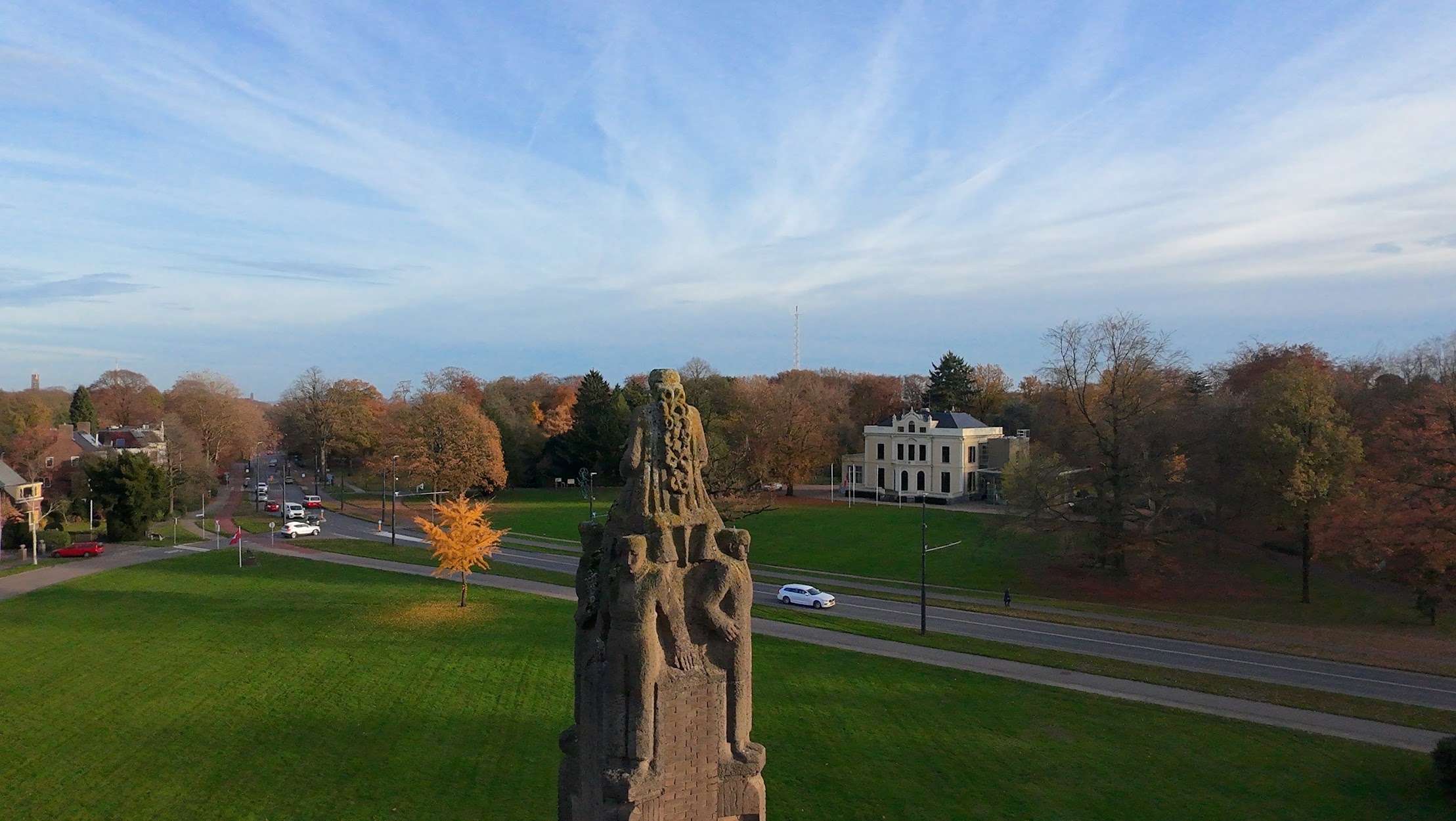
Those five figures still stand at the top: a central figure of Freedom raised above four others, soldiers and civilians together. The choice was deliberate. At the foot of the column the four reliefs carry the same idea. East is the landing. South is the women of Oosterbeek tending the wounded. West is the resistance working alongside the Airborne. North is the last stand. Three of the four show the people of the village, not the soldiers who came to it. The monument was raised to honour the airborne dead, but the villagers put themselves into the stone beside them.
De Naald is a fixed point on our Arnhem and Oosterbeek tours, and it sits within walking distance of the Airborne Museum at Hartenstein and Urquhart’s wartime headquarters, as well as the attic on the Zwarteweg where the general spent thirty hours cut off from his own division during the battle.
Sources
- Oorlogsgravenstichting, Oosterbeek, ‘Airborne-monument’ (first stone 25 September 1945, unveiling 17 September 1946, funding by the inhabitants, withdrawal figure)
- Airborne-monument (Oosterbeek), Wikipedia (Maris’s disputed crown, temporary crowning, definitive group 1947)
- TracesOfWar, Airborne Monument Oosterbeek (the four reliefs and their subjects)
- NOS, het bevrijdingsjaar, ‘Oosterbeek lijkt een oorlogskerkhof’, 30 July 1945 (field-grave recovery, Theirs is the Glory filming, Urquhart’s July 1945 quote from the Arnhems Dagblad, 19 July 1945)
- Vrienden van het Airborne Museum, Newsletter 91, 2003, obituary of Jan ter Horst (the September 1945 bicycle roadblock and the founding of the annual commemoration)