
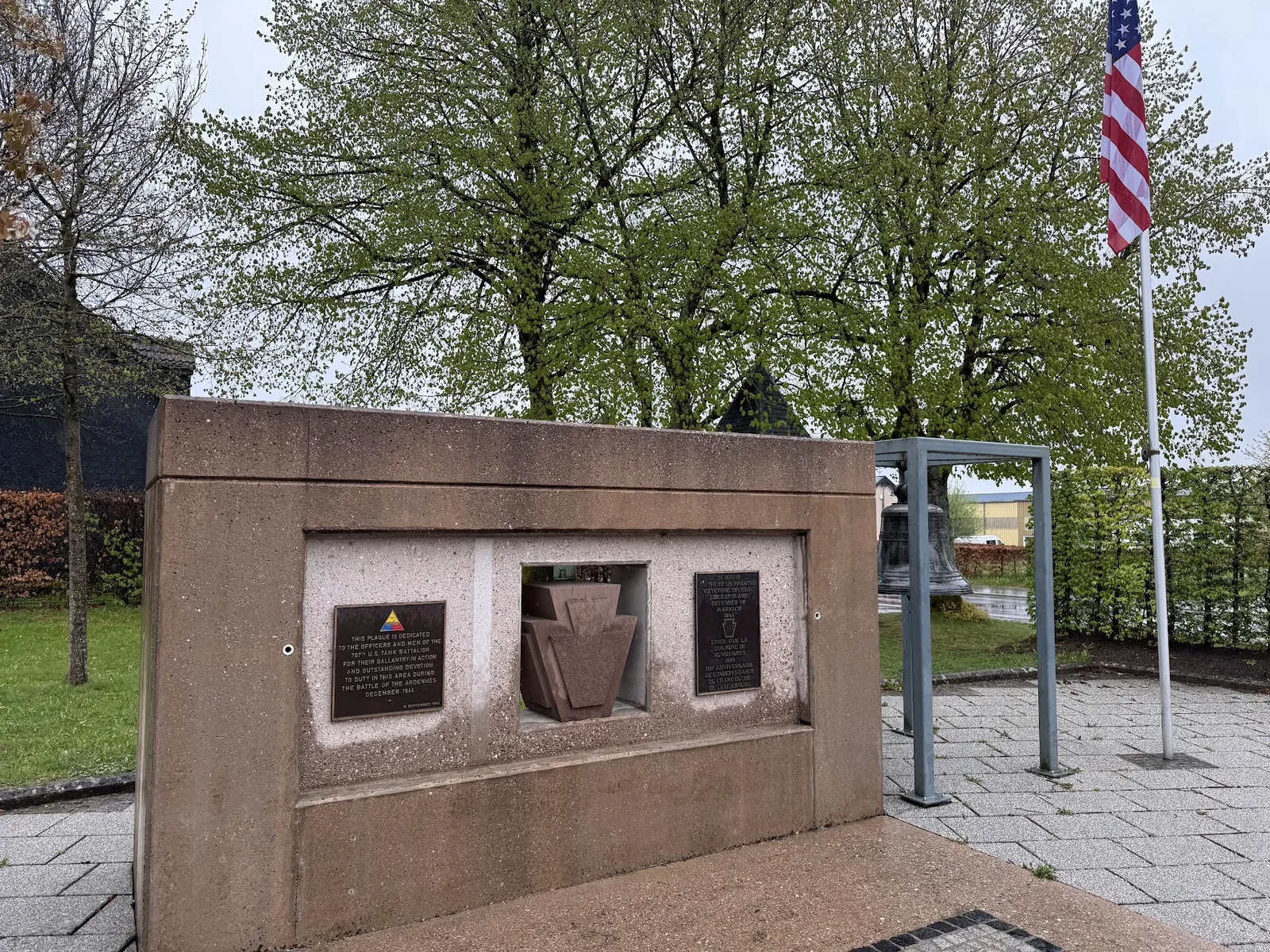
A low stone monument stands at the crossroads in the centre of Marnach. It carries two bronze plaques with a carved red stone set in a recess between them. The right-hand plaque reads: “In honor to the 28th U.S. Infantry ‘Keystone’ Division, liberator and defender of Marnach 1944”, and records that the commune of Munshausen erected the monument in 1989, the 150th anniversary of Luxembourg’s independence. The left plaque, dated 11 September 1994, is dedicated to the officers and men of the 707th Tank Battalion and carries the triangle of the US Armored Force. A bell hangs beside it in a steel frame. An American flag flies over the paving. A short walk away, the communal war monument lists the dead of Marnach and Roder, 1940 to 1945.
Traffic on the N7 passes the crossroads without slowing. That road is why the village was fought over.
Marnach sits on the ridge the Americans called Skyline Drive, about five kilometres west of the Our and the German border. From the crossing at Dasburg the road climbs to Marnach, then drops through the woods into Clervaux and runs on westward. It was one of the few routes in the sector that would take heavy armour, and the 2nd Panzer Division needed it to reach the river Clerf and, beyond that, Bastogne.
On the 28th Infantry Division day of my Battle of the Bulge tours we follow the attack in its own order: the Our crossing at Dasburg, then Hosingen and Marnach, then down into Clervaux and on to Wiltz.
The 28th Division had come out of the Hürtgen Forest in November all but destroyed, and was sent to the Ardennes to rest and absorb replacements. Its 110th Infantry Regiment held a front of nine to ten miles with two battalions, based on strongpoints in the villages. Company A at Heinerscheid, Company B at Marnach, Company C at Munshausen, battalion headquarters at Urspelt, regimental headquarters in the Hotel Claravallis in Clervaux under Colonel Hurley Fuller. The 2nd Battalion was in divisional reserve at Donnange. Between the villages there were patrols and little else.
The bombardment began at 05:30 on 16 December 1944. II Battalion of Panzergrenadier-Regiment 304 crossed the Our in rubber boats in the dark and lost men in a minefield. By 08:00, in Cole’s words, the leading Germans had reached Marnach. The regiment belonged to the 2nd Panzer Division of XLVII Panzer Corps, in Manteuffel’s Fifth Panzer Army. The division had a new commander, Meinrad von Lauchert, appointed days before the offensive opened.
Marnach was held by Company B, 110th Infantry, and a platoon of the 630th Tank Destroyer Battalion, which the regimental report identifies as its reconnaissance platoon. Several published accounts add five 57mm guns of the 630th to the defence. That attribution does not hold. The 630th was a towed 3-inch battalion, and the 57mm guns in this sector belonged to the infantry’s own antitank platoons.
Fuller’s report names the company commander as Lieutenant Carson, badly wounded during the morning. Captain J. H. Burns, executive officer of the 1st Battalion, went up to Marnach and took command of the strongpoint. The fighting went house to house. Substantial elements of the German regiment were held up in and around the village for the rest of the day.
Later in the afternoon Company C came across from Munshausen with medium tanks of the 707th Tank Battalion. What happened next is not settled. Captain Wright’s battalion narrative has Company C and the tanks entering Marnach at about 17:30 on 16 December, the Germans withdrawing as they arrived. Fuller calls the counterattack temporarily successful. Cole’s official history records the tank movement but no recapture.
Shortly before dark the German engineers finished 60-ton bridges at Dasburg and Gemünd, and the tanks and assault guns crossed. About dusk the Marnach garrison radioed that half-tracks could be heard moving toward the village. That was the last word from Marnach. The village was breached at midnight, when tanks and self-propelled guns of Panzer-Regiment 3 came in.
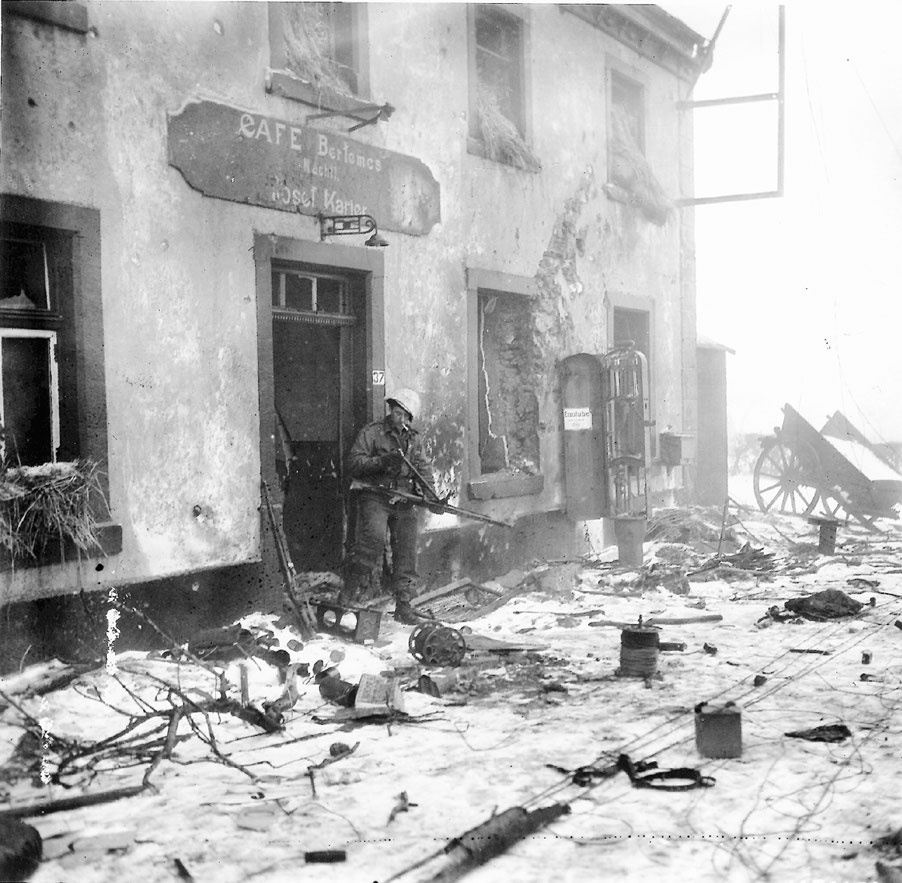
Three American attacks went in toward Marnach the next morning, from the west, the south and along the Skyline Drive from the north. The northern prong, the light tanks of Company B, 707th Tank Battalion, was caught in column on the road outside Heinerscheid and shot to pieces by high-velocity guns and bazookas. The southern prong reached Marnach and reported that no friendly infantry could be found. Cole’s summary is that the American pincers had failed to constrict.
At 18:25 on 17 December Fuller telephoned the 28th Division chief of staff to report that his command post was under fire and that German tanks were in Clervaux. By his own account he left through a window onto a steel ladder and went cross-country towards Eselborn. He was captured soon afterwards. In the château above the town, 102 officers and men of the regimental headquarters company held on. Radio contact ran until 05:28 on 18 December. Engineers and self-propelled 88s set the château alight and the garrison surrendered later that morning.
There is no official casualty return for the regiment in this period. Members of the regimental staff put the figure to Cole at about 2,750 officers and men. Cole declined to assess the delay in hours, writing that it is impossible to measure the violence done to the 2nd Panzer Division’s timetable, but that the division’s race to Bastogne was lost at the Clerf crossings. The leading troops of the 101st Airborne Division reached Bastogne on the night of 18 December.