
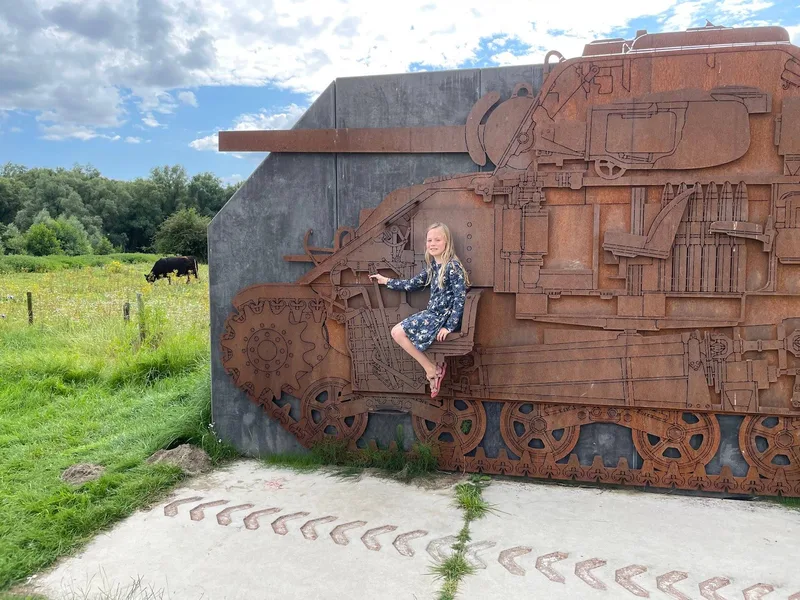
A Sherman tank cut from rusted steel stands against a concrete wall at Meinerswijk, on the south bank of the Nederrijn at Arnhem. It is drawn as a cutaway, with the engine, drive train and seats laid open and the gun reaching past the edge of the wall. Track marks run across the paving at its foot. The relief marks a Cold War defence that was built in secret and never used.
A river turned into a barrier
In the early 1950s the Dutch expected a Soviet attack to reach their border quickly. The aim was to slow it long enough for Allied support to arrive, and the tool was water. From 1951 the Netherlands built what became the IJssellinie. Steel caissons were held ready at three points: in the Waal near Nijmegen, in the IJssel at Olst, and in the Nederrijn here, between Meinerswijk and the Rosandepolder. The Arnhem dam was known as Object II.
If war came, the caissons would be sunk across the rivers and the gaps closed with scuttled barges and dredged sand. The Rhine and Waal would then be forced into the IJssel, which would flood its valley along a 127-kilometre strip from the Ooijpolder east of Nijmegen to IJsselmuiden near Kampen. The water was meant to be too deep to wade and too shallow for boats. Around 400,000 people living in that strip would have had to leave their homes.
Meinerswijk lies less than three kilometres downstream of John Frost Bridge, the centre of my Arnhem tour. Seven years after the 1st Airborne Division fought for that bridge, the army was preparing to hold the same river against a different enemy.
Tanks without tracks
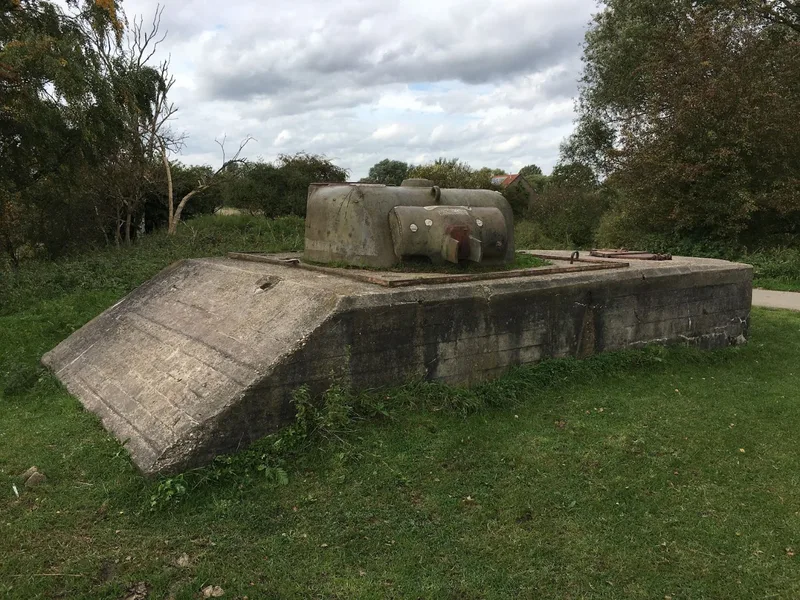
A dam is only useful if it can be held. To defend Object II the army turned surplus Second World War Shermans into fixed gun positions. The tanks were stripped, and the hulls set in concrete so that only the turret stood above ground. Crews reached the gun through a small door in the concrete. More than twenty of these tank casemates were placed around Arnhem, on both banks of the river. Elsewhere on the line, Canadian-built Ram tanks were used the same way.
What remains
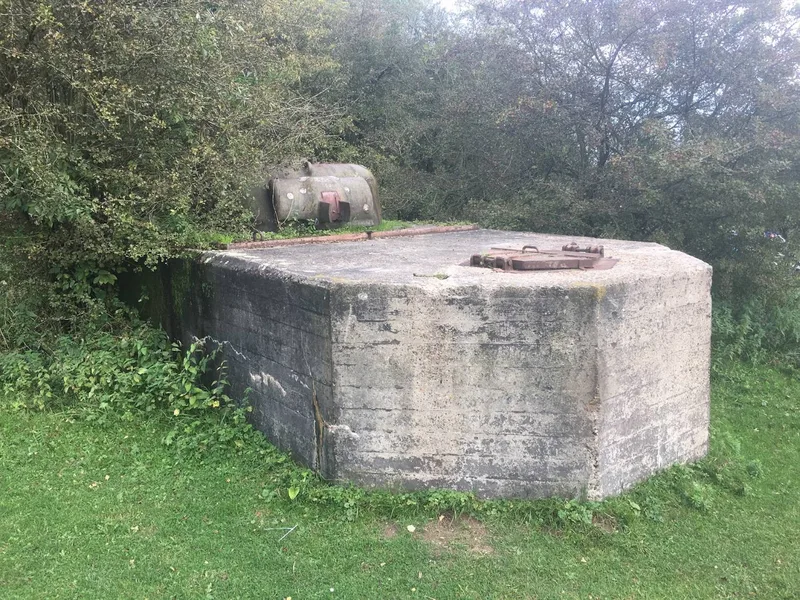
The IJssellinie was never tested. Once NATO moved its defence forward to the German border, flooding the IJssel valley no longer made strategic sense, and in 1964 the line was stood down. Much of it was demolished. Four of the Meinerswijk casemates survive, their gun barrels removed.
The plan was kept classified for decades, but it was not hidden from everyone. A Soviet staff map from 1987 already showed the area the Dutch intended to flood.