
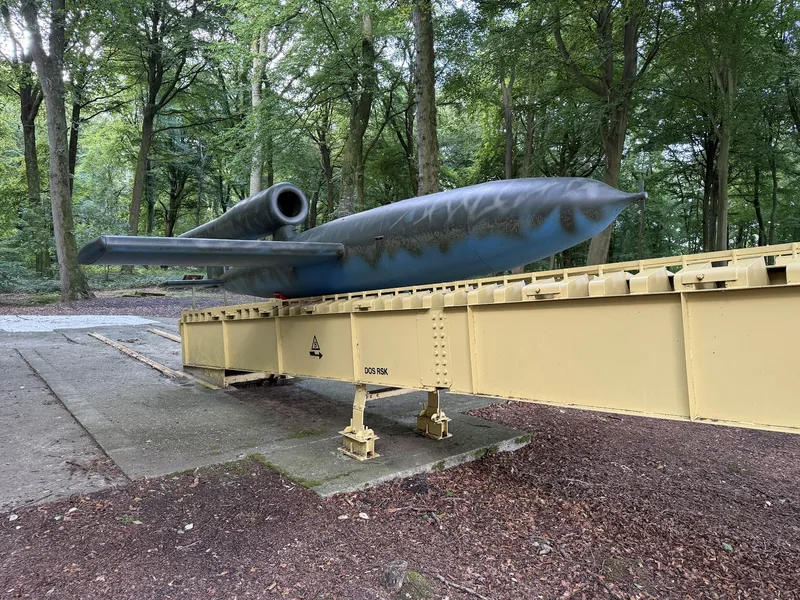
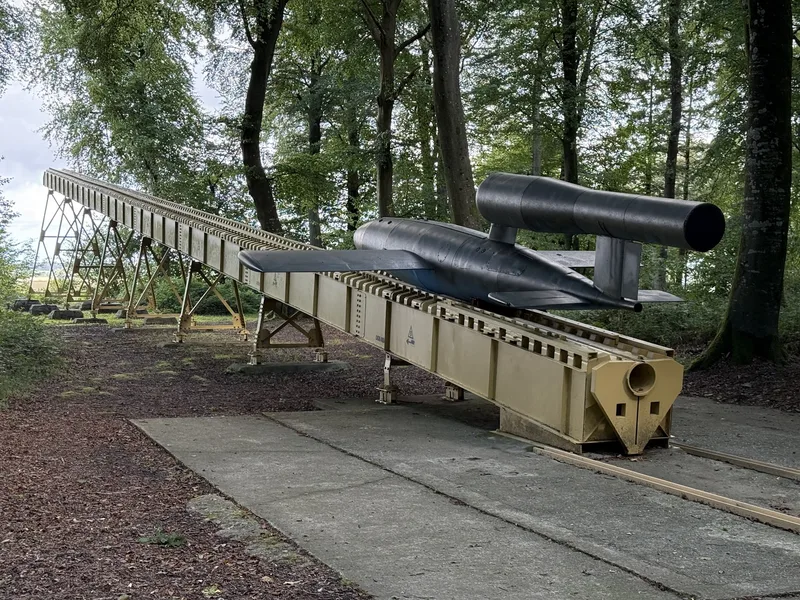
The launch ramp points at 328 degrees. London lies 206 kilometres down that bearing.
The ramp sits in the forest of Eu at Guerville, on the high ground between the Bresle and the Yères. This is Site Nr 161, one of nineteen V1 launch sites built in these two valleys.
The V1 was the Fieseler Fi 103. An Argus As 014 pulsejet sat above the fuselage and fired about fifty times a second, which is where the buzzing came from. In the nose were 850 kilos of Amatol. It flew at around 640 kilometres an hour with no pilot and no radio link. A pair of gyroscopes held pitch and yaw, a magnetic compass held the heading, and a small propeller on the nose counted off the distance flown. When the count ran out, the machine pitched into a dive. Everything about where it came down was decided on the ramp, before launch. Hence the bearing.
The reason it is hidden in a forest is the previous generation of sites. In 1943 the photographic interpreters at RAF Medmenham worked out what the Germans were building along the Channel coast. Flight Officer Constance Babington Smith, who ran the aircraft recognition section there, found the V1 itself on reconnaissance photographs of Peenemünde. The launch sites in France had long curved storage buildings that looked like skis from the air, and the Allies named them ski sites. Bombing began on 5 December 1943. Babington Smith was appointed MBE in 1946 and awarded the American Legion of Merit.
So the Germans stopped rebuilding the ski sites and put up replacements through the winter of 1943 to 1944: minimal concrete, wooden huts that went up in days, netting strung between the trees. Site Nr 161 is one of these. Nothing here is large, and that was the point.
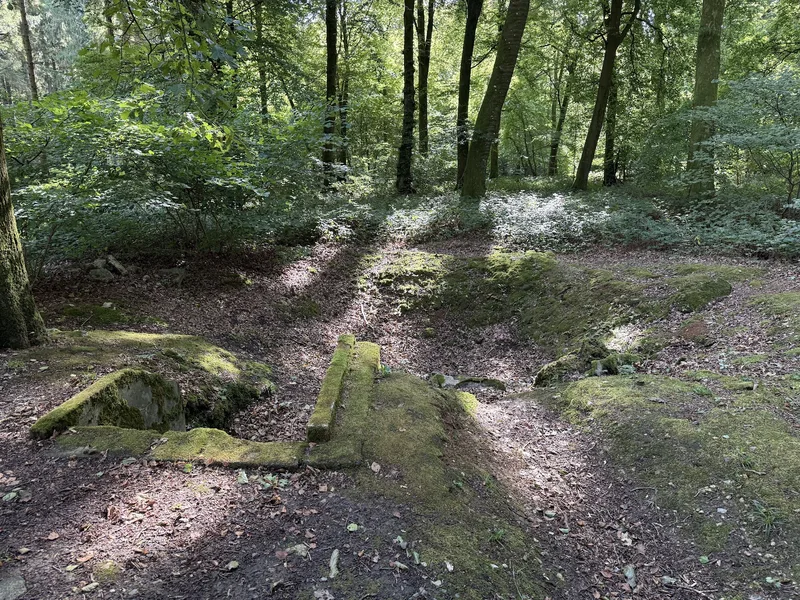
Enough survives to read the layout. The ramp, aligned on London. The firing bunker. The concrete base of the Richthaus, the non-magnetic building where the compass and gyroscopes were set, built without ferrous metal anywhere in it. The compressor garage, the water tanks, the foundations of the reception building. And the craters.
Flak-Regiment 155(W), commanded by Oberst Max Wachtel, ran the campaign against England. It opened on the night of 12 to 13 June 1944, and local records name Guerville and Mont Gournoy as the sites that fired the first V1s in Seine-Maritime. The opening was close to a failure. Ten flying bombs were launched. Four failed on the ramps. Two crashed into the Channel. Four crossed the English coast, and one hit the railway bridge over Grove Road in Bethnal Green, in east London, killing six people. Which of the ten came off this ramp is not recorded.
Three nights later the regiment had it working. On the night of 15 to 16 June, 144 V1s reached England. Around 10,000 were launched against the country in total, of which 2,419 reached London. About 6,184 people were killed and 17,981 injured. By August 1944 the guns, the fighters and the balloon barrage were bringing down roughly 80 percent of those that crossed the coast.
Allied aircraft photographed Site Nr 161 within weeks of it firing, and the bombing began in early July 1944. The first raids missed. Later ones did not. The compressor garage still carries the damage from a 250 kilo bomb, and the craters sit among the trees. In August 1944, with Allied ground forces coming up out of Normandy, the crews abandoned the site and withdrew north.
The campaign outlasted the site. Launching moved to ramps in the Netherlands and to Heinkel He 111s flying over the North Sea, and the last V1 to reach England came down in a field at Datchworth in Hertfordshire on 29 March 1945.