
In the cemetery at Erp stands a propeller as a memorial. It comes from a C-47 Dakota named “Sonya”, an American transport aircraft that crashed on the bank of the river Aa on the afternoon of Sunday 17 September 1944. A few minutes before the crash it had dropped fourteen paratroopers over the drop zone near Eerde. When they jumped, the aircraft was already on fire. That they still landed in the right place was down to the choice the pilot made.
Chilbolton, Sunday morning
On the morning of 17 September the airfields of southern England were packed with aircraft and gliders. Operation Market Garden began that day.
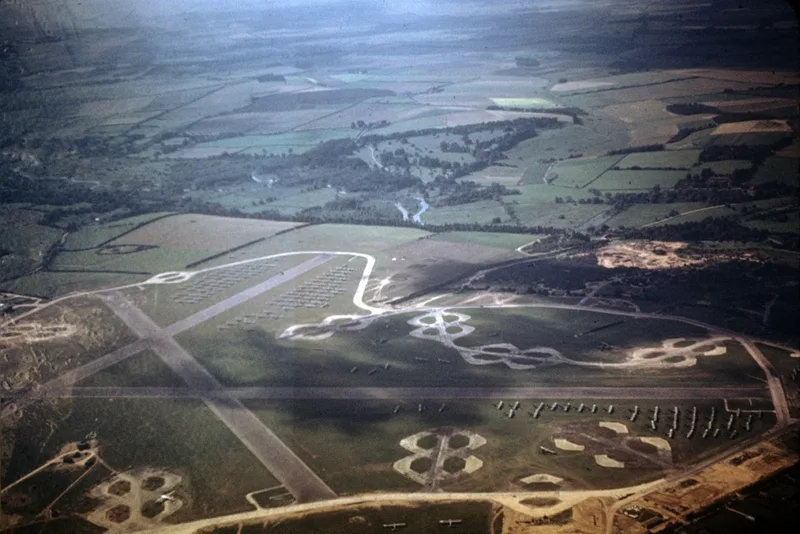
At Chilbolton airfield, in the south of England, serial A-8 stood ready. A serial was a group of aircraft that flew as a single unit to a single drop zone. This one counted 45 C-47s of the 304th and 305th Troop Carrier Squadrons, both part of the 442nd Troop Carrier Group. On board were the 3rd Battalion of the 501st Parachute Infantry Regiment and the 3rd Platoon of B Company, 326th Airborne Engineer Battalion. Their objective was Drop Zone A, between Eerde and Veghel. The regiment had to seize the bridges in Veghel over the Aa and the Zuid-Willemsvaart canal. The 3rd Battalion had to secure Eerde and the drop zone itself. The aircraft took off between 10:25 and 11:25 British time.
The crew
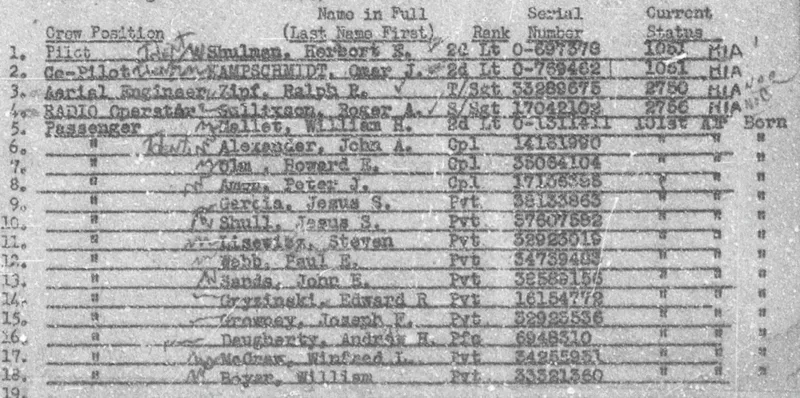
One of those 45 aircraft was C-47 43-15111 of the 304th Squadron, with the squadron code V4-O on the fuselage and the name Sonya. The crew numbered four:
- 2nd Lt. Herbert E. Shulman, pilot
- 2nd Lt. Omar J. Kampschmidt, co-pilot and navigator
- T/Sgt. Ralph R. Zipf, flight engineer
- S/Sgt. Roger A. Gullixson, radio operator
Shulman was 25 and came from Chicago. After two years of college he worked as a routeman, a driver with a fixed delivery route. In July 1942 he enlisted as a private in the Air Corps. He was married and had a young son, David, born after his father had already left for Europe. By mid-1943 he was a pilot and a lieutenant, and in June 1944 he had already flown over Normandy. Omar Jean Kampschmidt was twenty, unmarried, and came from Oakland, California, where his mother Olive lived. He had joined up in December 1942.
Behind them in the cabin sat a stick of fourteen paratroopers of the 101st Airborne. A stick was the group that jumped from one aircraft, led by a jumpmaster. Here that was 2nd Lt. William H. Mallet. Among his thirteen men were Corporal John A. Alexander and Privates Jesus S. Garcia, Paul E. Webb, John E. Sands, Andrew H. Daugherty and William Boyer. Under the fuselage hung containers of weapons, ammunition and supplies, to be dropped over the drop zone on their own parachutes.
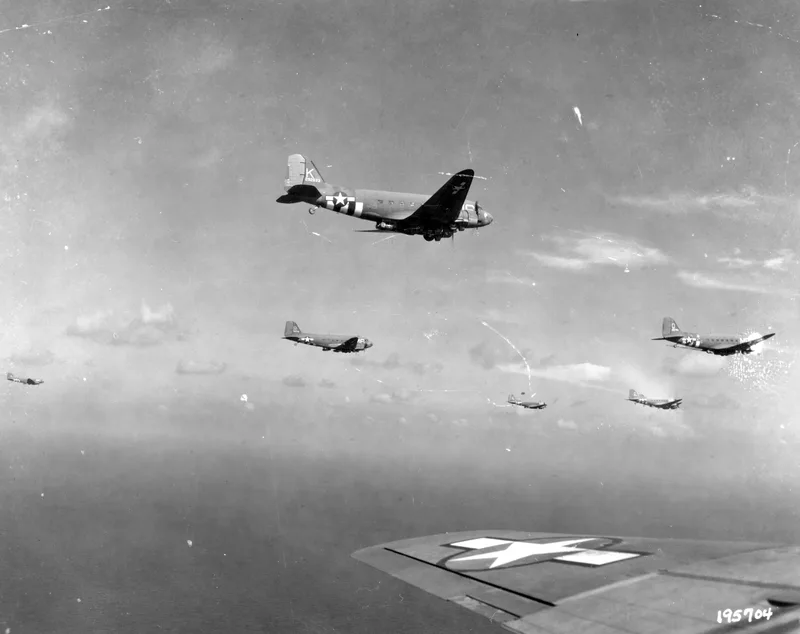
The C-47 was the military version of the DC-3 airliner. It was a reliable aircraft, but it was not built for war. The crew had no armour, and the fuel tanks were not self-sealing. A hit in a wing, where the fuel tanks sat, could quickly set it on fire.
The southern route
The aircraft carrying the 101st flew the southern route. They crossed the Belgian coast at Ostend, flew over a Belgium that was largely liberated to Geel, and then crossed the front line near Lommel. From that moment they were over occupied Netherlands, and the German anti-aircraft guns along the route opened fire at once.
For a Dakota pilot, that last stretch was the most dangerous part of the flight. To put his paratroopers down in the right place he had to fly low and slow, in formation and on course. Evading the flak was not an option.
Over the drop zone
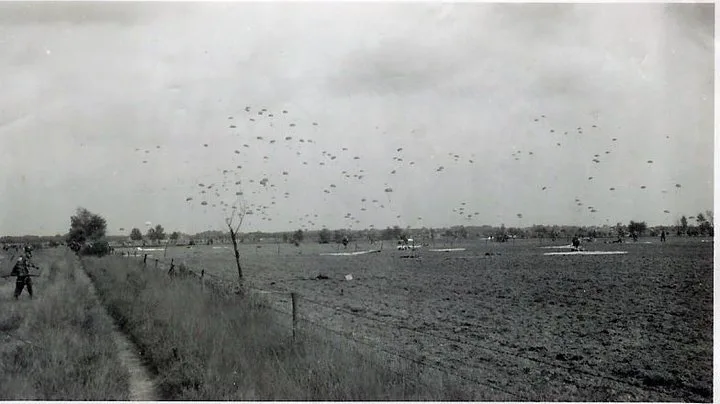
About five minutes short of the drop zone, near Eindhoven, the Sonya was hit by German anti-aircraft fire. The underside of the aircraft caught fire. The drop zone was still more than twenty kilometres (some 13 miles) away. What Shulman did next is told in Cornelius Ryan’s A Bridge Too Far. According to Ryan, he radioed his flight leader: “Don’t worry about me. I’m going to drop these troops right on the DZ.”
Ryan also quotes a paratrooper in another aircraft, Sergeant Charles A. Mitchell. He saw the plane to his left trailing flames from its port engine while the pilot held it steadily on course. The entire stick jumped right through the fire over the drop zone.
The official loss report, the Missing Air Crew Report (MACR), confirms it. A pilot in the same formation stated:
“I saw the plane on fire over the DZ but the paratroops and parapacks were dropped on the DZ. The plane continued in a Northerly direction after the formation made a left turn. The plane cut under the formation and was rapidly losing altitude when last seen. Three men jumped out but only two parachutes were seen to open.”
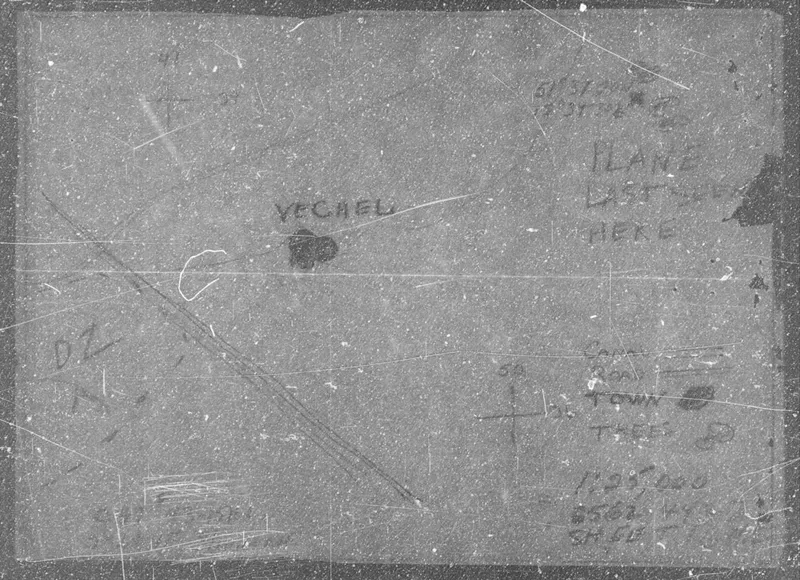
Shulman held his burning aircraft straight until the last man was out. Only when the containers had also gone was his task done. The formation turned for home, but the Sonya could no longer follow. Shulman left the formation and held the aircraft level, long enough to give his crew the chance to bail out. Ralph Zipf and Roger Gullixson jumped. Their parachutes opened and both landed safely.
Over Erp
Between two and three o’clock, people in Veghel and Erp saw an aircraft come in low from the direction of Veghel, heading straight for Erp. At first there was only a small point of light under the fuselage. Within moments it became a sheet of flame. After four years of occupation and a string of crashed aircraft, everyone in Erp knew what that meant, and the course pointed straight at the village.
Then part of a wing broke away. The Sonya swung sharply to the right and went straight down. Most of the aircraft came to rest on the bank of the Aa and in the river at Vogelenzang, in the bend the river makes there. Wreckage also lay in a nearby field. People in Erp saw a human figure fall along with the debris.
People from Erp, Keldonk and Veghel ran towards the wreck at once, but the heat kept them back. The local police commander, A. Jong, held the onlookers at a distance. Harry Otten and Adr. Heijkants of the local resistance were quickly on the scene. A few German soldiers came to look but did not interfere. They had their hands full with the landings on the other side of the canal. Approaching a crashed Allied aircraft was officially forbidden, Heijkants later wrote, “but we were so lucky that we could carry the bodies of the airmen.”
About a hundred metres from the wreck, in the loose sand of a ploughed field, they found the body of a crew member. His parachute had not opened. As the harness straps were cut, he opened his eyes for a moment. The village doctor could only confirm his death. It was Herbert Shulman. Harry Otten took his papers and identity tags into safekeeping for the Allies, and Crosier brother Martien Brouwers knelt beside him and prayed.
So Shulman did not stay at the controls until the crash, as the story is often told. He kept the aircraft in the air until his crew could get out, and then jumped himself. He was probably the third man the MACR mentions, the one whose parachute did not open. Omar Kampschmidt never got out of the aircraft. His body was found late on Sunday evening, once the fire had died down, in the wreck lying partly in the water against the bank of the Aa. His skull was crushed and he had fractures in both arms and both legs. Why he did not jump, the sources do not say.
The MACR lists all four crew members as missing. It was compiled by James Guthrie, the group adjutant, from what the returning crews had seen. At Chilbolton nobody yet knew what had happened to the four men. Later, someone added by hand what had become of the fourteen paratroopers. Corporal John A. Alexander was killed on 26 September, nine days after the jump.
Two graves in Erp
The villagers decided to bury the airmen in the Roman Catholic cemetery at Erp. Wrapped in a sheet, Shulman was carried to the cemetery on a small hand-drawn bier by three young men from the village. The parish priest, Dr. A. Meuwese, led the burial, with many villagers gathered around the open grave. A photograph of the ceremony survives and also hangs in the Liberation Museum at Groesbeek. Kampschmidt was buried beside him. Local memory places the burials on Sunday evening and Monday morning. The cemetery caretaker later gave the US Army a single date for both: 19 September 1944.
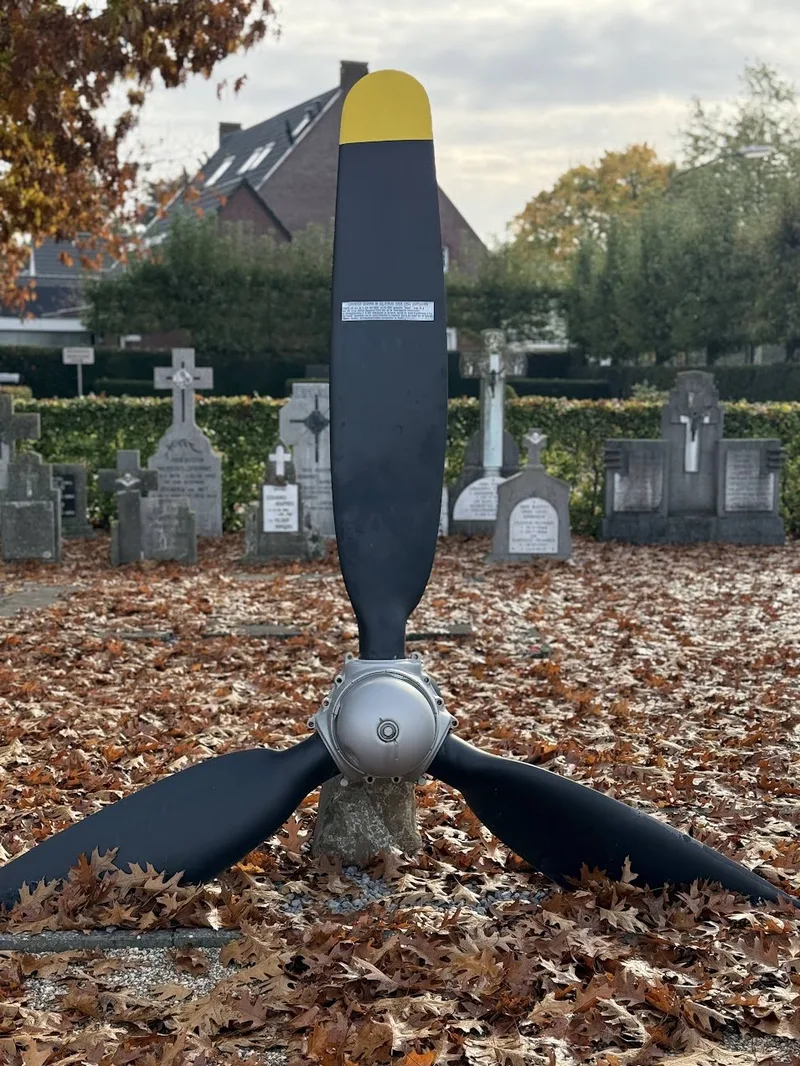
As a grave marker the villagers used one of the Sonya’s propellers, which had come down intact in the field not far from the wreck. The blades carried the names of the two airmen, with their dates of birth and death.
Later a sergeant of the 101st collected Shulman’s papers and identity tags from Harry Otten. His name was never recorded. When the 3060th Graves Registration Company opened the graves in Erp on 5 July 1945, neither man still had a tag. On 11 July they were buried at Margraten as unknowns, T-1769 and T-1770. Only the burial report from Erp and their dental charts gave them back their names.
In Oakland, Olive Kampschmidt still did not know in 1946 where her son lay. She wrote to Erp, and in July 1946 Heijkants replied: “I am sure of it, that the two heroes who died for the freedom of the world, were killed instantly, so that they did not suffer.” An Air Corps officer forwarded a copy of that letter to Washington, noting that the mother was “quite upset over the lack of information received concerning her son’s death and the whereabouts of his grave.”
Shulman received two high awards posthumously. In 1945 the United States awarded him the Distinguished Service Cross, the second-highest American decoration for valour. By Royal Decree of 17 October 1946 he was made a Knight 4th Class of the Military William Order, the highest Dutch award for bravery. In June 1948 the Dutch consul in Chicago, Mr Van der Mortel, pinned the insignia on his son David, then four years old.
Both families chose to bring their men home. On 6 December 1948 Shulman’s remains were delivered in Chicago, and he was buried at Westlawn Cemetery, next to his mother. Kampschmidt followed shortly afterwards, to the Mountain View Mausoleum in Oakland. Shulman was Jewish. At Margraten he had lain under a cross, and the bronze grave marker the Army sent to Chicago in 1949 also carried a cross. His father, Abraham, wrote letters for more than six months until, in March 1950, a marker with a Star of David was shipped.
The propeller
Nothing else of the Sonya survived. A resident of Vogelenzang later remembered that a scrap dealer from Boekel broke up the wreck and carted it away in 1945 or 1946.
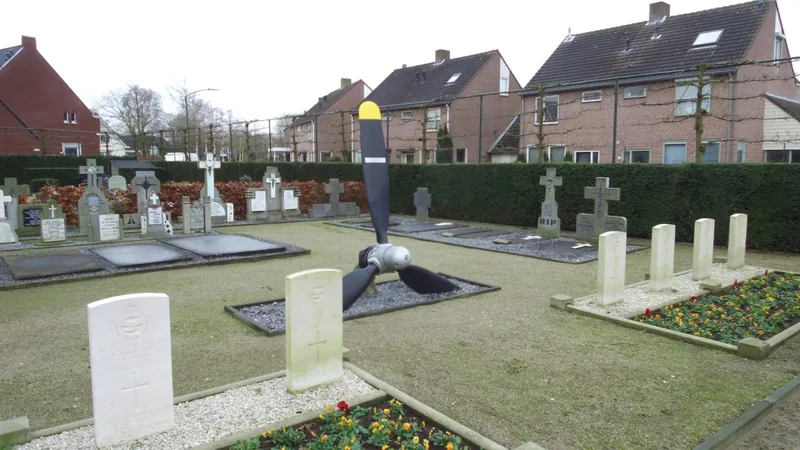
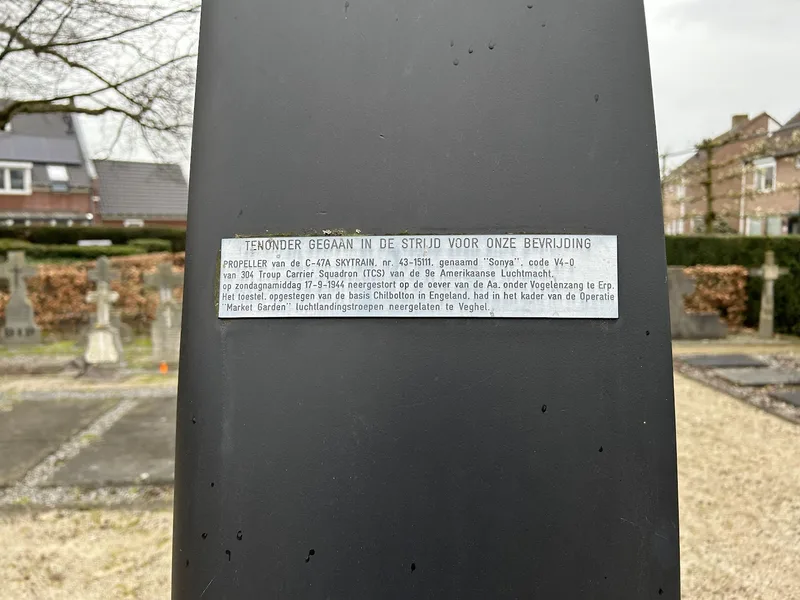
The propeller stayed in the cemetery, even after the graves it marked were emptied in July 1945. It still stands there, behind the graves of nine British servicemen. The Graves Registration report records the numbers on its three blades: FB 6991, 6992 and 6993. In 2005 Frans van Hek, a resident of Erp, had the propeller restored and placed on a new base with a short text, here in translation:
PERISHED IN THE STRUGGLE FOR OUR LIBERATION
PROPELLER of the C-47A SKYTRAIN, no. 43-15111, named “Sonya”, code V4-O of 304 Troop Carrier Squadron (TCS) of the US 9th Air Force, crashed on the afternoon of Sunday 17-9-1944 on the bank of the Aa, below Vogelenzang at Erp. The aircraft, having taken off from the base at Chilbolton in England, had dropped airborne troops at Veghel as part of Operation “Market Garden”.
In 2018 I filmed the drop zone, the crash site and the propeller for a video on Herbert Shulman.
Sources: Missing Air Crew Report 43-15111; Individual Deceased Personnel Files (IDPF) of 2nd Lt. Herbert E. Shulman (O-697378) and 2nd Lt. Omar J. Kampschmidt (O-769462), including the letter from Adr. Heijkants to Olive Kampschmidt, 12 July 1946; Distinguished Service Cross, General Orders 1945 No. 29; Royal Decree of 17 October 1946 No. 26 (Military William Order); Cornelius Ryan, A Bridge Too Far; Heemkundekring Erthepe, De luchtoorlog XIII–XV and XXV (nos. 77–79 and 89).